In Flight: March 2009

House Party: March 2009
Beer Pong: July 2009

The beautiful cloudscape of the sky and a $10 digital camera from Walgreens (the Vivitar MARSCAM). 3/25/2009.
A lo-fi digital photo taken from an airplane window while still on the ground in 2009, shot with a Vivitar Marscam—a bare-bones toy camera powered by a single AAA battery. The photo is hazy and pixelated, with visible digital noise. In the frame, part of the aircraft’s wing juts in from the right side. On the tarmac below, a couple of service trucks sit parked on the wet concrete, which reflects light from the overcast sky. An orange traffic cone stands nearby, adding a splash of saturated color. The moisture on the pavement suggests recent rain or ongoing drizzle. The image has that charming, glitchy, low-res texture typical of early budget digital cameras.

take-off

A blurred aerial photo taken moments after takeoff, from the same Vivitar Marscam. The ground below is visible but smeared and distorted due to motion blur and the camera’s low frame rate. Faint patchworks of land—possibly fields, roads, or suburban sprawl—can be seen in pastel tones of green and brown, melting into one another. The horizon line is hard to define. The whole photo feels ghostly, with poor focus and a digital haze, capturing the disorienting sense of movement and the Marscam's limitations in dealing with speed and distance.
A simple, washed-out view from the airplane window showing the Earth’s surface below and a faint horizon line above, taken mid-flight with the Vivitar Marscam. The bottom half of the image displays textured land patterns—likely farmland or industrial areas—though the resolution is too low to be certain. Above that, the pale sky bleeds into the landscape in a vague gradient. Colors are desaturated and artifact-heavy, with compression noise scattered throughout the frame. A sense of altitude is present, despite the camera's lack of clarity, giving the shot a dreamlike feel.
A classic airplane wing photo, shot in low resolution with a Marscam from the passenger window. The aircraft’s wing spans across the image, a silvery gray shape with visible features. The background is a hazy expanse of sky, dull blue and cloudless, with significant image noise and blur. The photo’s nostalgic, degraded digital aesthetic evokes a mid-2000s internet vibe, with soft tones and blown-out highlights. The image is charming in its minimalism and imperfection.

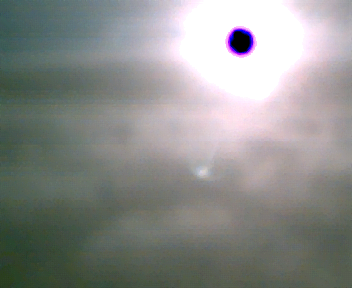
An unintentionally surreal image caused by a sensor glitch or overload on the Vivitar Marscam when pointed directly at the sun. At the center is a sharp black dot with an intense, luminous purple outline—clearly not present to the human eye, but created by the camera’s inability to process the extreme brightness. The surrounding sky is washed out and vaguely gray-blue, offering no detail. This artificial “black sun” looks like a cosmic anomaly or a retro sci-fi special effect, highlighting the weirdness and unpredictability of ultra-cheap digital tech.

i shot the sun to see what would happen
Another glitchy solar image from the Marscam, where the sun has again been transformed into a strange artifact. A dense black orb with a glowing magenta or violet halo sits mid-frame, possibly surrounded by faint light flares or digital streaks. The shape looks unnatural and jagged at the edges, contrasting sharply against the flat, pale sky. The color distortion and pixel fringing give the photo a vaporwave-esque surrealism, despite being just a janky point-and-shoot mistake.

it overloads the little camera and creates a delightful error
A third photo of the sun taken from the airplane window using the Marscam, continuing the strange visual glitch theme. The sun is rendered again as a dark central dot surrounded by an electric purple corona, with less contrast than the others but similar color distortion. Background details are minimal, mostly a featureless blur of sky. These failed attempts to capture sunlight accidentally produce something more artistically weird than technically accurate—an unintended visual artifact from an obsolete toy camera in flight.

the camera does not preview photos, so i had no idea this happened until after
A washed-out photo taken from an airplane window in 2009 with a Vivitar Marscam, showing the open sky in hazy pale blue tones. The curved edge of the plane window is just barely visible along the bottom of the frame, forming a soft dark outline that contrasts with the otherwise minimal sky. There's no real texture or cloud detail, and the photo is grainy, pixelated, and color-shifted—typical of the Marscam’s barebones digital sensor. The photo conveys a vague sense of altitude and quietness, like staring into a blank canvas from thousands of feet up.
Another low-resolution sky photo shot through the plane window on the same 2009 flight with the Vivitar Marscam. This time, part of the airplane’s wing appears in the lower right quadrant, angled slightly upward. The sky dominates the rest of the image in flat, desaturated gray-blue. The image quality is very soft and blotchy with plenty of digital noise and faint artifacts. The plane wing is indistinct but adds a mechanical presence to the otherwise airy and vague scene, creating a classic airplane-window aesthetic filtered through 2000s budget camera jank.
A dreamy, ghostly view of fluffy white clouds from above, captured mid-flight with the Vivitar Marscam. The clouds appear like a cotton blanket stretching across the bottom of the frame. Their texture is soft and hazy due to the camera's extremely limited resolution and poor dynamic range. Above the clouds, the sky fades into a faint gradient of blue. The whole photo has a vaporous, low-contrast look, unintentionally ethereal due to the Marscam’s primitive sensor and aggressive compression.
A second cloudscape taken just minutes apart from the previous, again on the same flight using the Marscam. This image offers a slightly clearer definition between the cloud layer and the sky above, though it remains glitchy and pixelated. It has the clouds looking soft and dappled like brushed chalk. The upper half of the image is paler than the bottom, creating a two-tone split. There’s still no sharp detail, but the abstract feel of the photo makes it strangely beautiful in a glitch-art sort of way.

A rare self-portrait taken on the flight with the Vivitar Marscam, where the photographer (me, Ethan) turned the toy camera toward themselves. The result is a blurry, low-res image of a young person with light skin and dark-rimmed glasses, looking upward slightly toward the window light. Their face is mostly in shadow, softly lit from one side, with some facial detail visible despite the camera’s muddy pixelation. The lack of detail feels accidental but somehow intimate, like a forgotten webcam snapshot from a long-lost internet archive.

myself

A post-landing photo inside the airport (Minneapolis? Eau Claire?), taken with the Vivitar Marscam while walking through a hallway or gate area. The ceiling dominates the frame, with parallel silver-gray metal beams running across in regular intervals. The yellow-green lighting is industrial, casting a slightly cold glow on the otherwise drab structure. The photo has the flat, colorless tone of a place built for utility, not beauty. Blurring and compression are heavy, warping some of the structural lines and leaving artifacts across the image. It feels mundane but somehow haunting through the Marscam’s distorted lens.

post-landing


By the way, if you have an old MarsCam/Vivitar digital camera you’ve been struggling with, I reverse engineered the old driver and made one that works with modern Windows. See my MarsCam Modern driver/downloader for yourself.

House Party: March 2009
Beer Pong: July 2009

Comments are closed.